English
 Tiếng Việt
Against the backdrop of rising lending interest rates, many people are becoming cautious about the real estate market. Plans to purchase homes, invest in land, or utilize financial leverage are being carefully reconsidered. Not a few middle-class investors are choosing to step back due to concerns about mounting interest payment pressures.
However, if you look closely at the market, you will see quite an interesting paradox: when interest rates rise, experienced investors are quietly making purchases.
Why do they continue to invest during a period that many consider risky? The answer lies in how they view market cycles and how they manage their finances when investing.
Interest Rate Pressure: Why Are Many Investors Hesitant?
To understand market psychology, consider a simple example.
Suppose a property is valued at approximately 10 billion VND and the buyer finances 70% of the value, meaning the loan is approximately 7 billion VND.
- When interest rates are around 10% per annum, monthly interest payments are approximately 58 million VND.
- However, if interest rates rise to 14% per annum, monthly interest payments can reach over 80 million VND.
The difference of over 20 million VND per month represents significant financial pressure for many families or investors utilizing leverage.
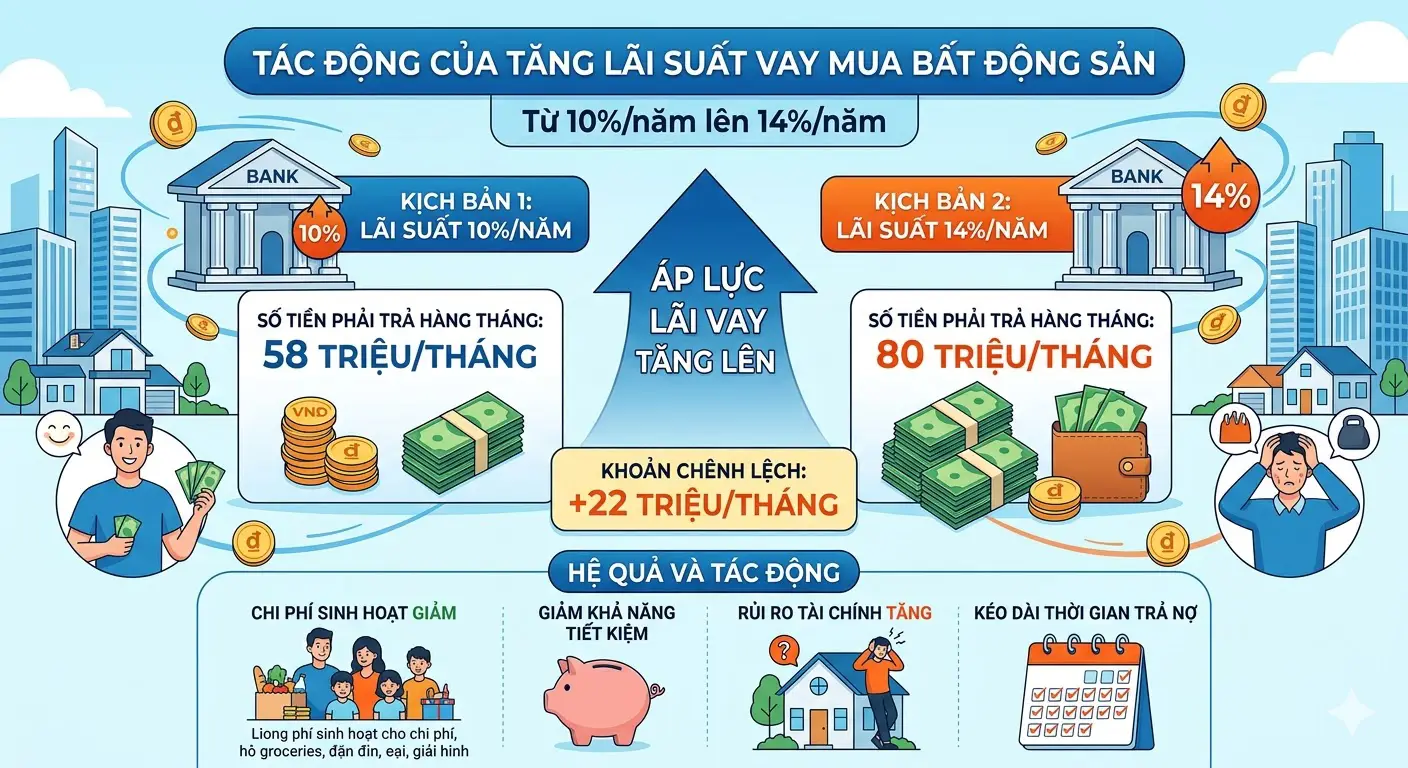
Since incomes do not typically rise proportionally while capital costs increase rapidly, many worry that holding real estate will become an unsustainable burden.
As a result, when interest rates rise, the market typically exhibits a cautious, wait-and-see mentality.
The Wealthy View the Market in Cycles
Experienced investors with years of proven expertise, however, typically do not assess interest rates within short-term periods.
They view the market through financial cycles and economic cycles.
In reality, periods of rising interest rates typically serve to:
- control inflation
- regulate credit flows
- stabilize the financial system
However, these periods of tightening typically do not last very long. When the economy requires growth stimulus, monetary policy typically gradually eases, and additional credit is injected into the market.
When capital flows return, real estate typically ranks among the major beneficiaries.
For this reason, investors who understand market cycles typically establish positions early, even before the market enters a pronounced upswing.
Opportunities Often Emerge When Markets Face Headwinds
During robust market cycles, nearly every investor seeks to participate. Prices appreciate rapidly, liquidity remains abundant, and optimistic sentiment prevails widely.
Conversely, when interest rates rise and the market cools, many investors begin to hesitate. However, it is precisely during this phase that investment opportunities often become more apparent.
Several readily identifiable factors emerge during challenging market periods:
- Sellers are more willing to negotiate on price
- Developers introduce attractive financing incentives
- Payment schedules become increasingly flexible

For investors with a long-term perspective, this is when market competition diminishes and the selection of premium assets becomes increasingly advantageous.
The difference lies in cash flow management
One reason financially strong investors can continue investing during periods of elevated interest rates is that they do not rely entirely on financial leverage.
Instead of maximizing debt, they typically:
- maintain conservative loan-to-value ratios
- preserve substantial cash reserves
- assess their capacity to sustain interest expenses over the long term
As a result, even if interest rates rise in the near term, they can maintain their assets without pressure to liquidate.
The ability to navigate market cycles represents a significant advantage for seasoned investors.

Project and Developer Selection Become Increasingly Critical
During periods of market volatility, the credibility of developers and project quality become especially important.
Projects developed by major institutions typically offer:
- clear legal documentation
- guaranteed construction timelines
- comprehensive amenity ecosystems
- banking partnerships for financial support
Additionally, many projects currently offer programs such as:
- interest rate subsidies during initial periods
- flexible payment schedules
- principal payment deferrals
These policies help buyers reduce financial pressure when interest rates are elevated. The Perspective of Experienced Investors
In practice, investment decisions made by experienced investors are typically based on comprehensive market analysis and long-term financial strategies, rather than being driven by short-term market fluctuations.
These investors typically focus more on:
- location and regional development potential
- urban planning and infrastructure
- developer reputation
- long-term asset appreciation potential
For this reason, even when interest rates rise significantly, demand for quality real estate products remains steady.
Market Perspective from Saigon Luxury
In the luxury real estate segment, Saigon Luxury is a specialized operator whose primary clientele includes entrepreneurs, high-net-worth investors, and individuals with extensive market expertise.
Through direct engagement with this client base, the Saigon Luxury team is well-positioned to observe how experienced investors navigate the market across different cycles.
Based on market observations, most luxury segment clients are not significantly influenced by short-term interest rate fluctuations. Instead, they prioritize long-term factors such as:
- intrinsic asset value
- regional infrastructure development potential
- project quality and legal compliance
- value appreciation potential in the coming years
This is precisely why the luxury real estate segment maintains stable transaction volumes, even during periods of market volatility.
Drawing on extensive experience in this segment, Saigon Luxury partners with clients throughout the investment journey—from market analysis and project selection to developing tailored investment strategies aligned with each phase of the real estate cycle.
What Should Investors Consider During High Interest Rate Periods?
High interest rates do not necessarily represent a poor investment window, though they do demand thoughtful deliberation rather than hasty action.
Investors may benefit from considering the following key principles:
First, carefully assess your financial capacity.
Ensure sufficient cash reserves to sustain your position through interest rate fluctuations.
Second, prioritize assets with genuine intrinsic value.
Locations with established infrastructure, clear urban planning, and demonstrated long-term growth potential tend to preserve value more effectively.
Third, leverage available financial support programs.
Many projects currently offer interest rate incentives and flexible payment terms, which can meaningfully reduce financial strain during the initial investment phase.
Conclusion
Rising lending rates will undoubtedly create near-term headwinds for the real estate market. However, for seasoned investors, this period presents not merely challenges but also opportunities to identify quality acquisitions.
The decisive factor is not market temperature, but rather how each investor interprets the cycle, manages cash flow, and selects appropriate assets.
In real estate investment, success often stems not from acquiring the most properties, but from purchasing at the right time with the right strategy.