When you are purchasing a villa or planning to invest in renovating a villa, you may encounter challenges in selecting furnishings that complement your home and reflect refined aesthetic taste. To navigate these decisions effectively, it is important to understand the different interior design styles available.
Classic Style
Classic interior design draws its origins from Greek and Roman architectural principles. In Vietnam, this style is commonly understood as intricately detailed designs inspired by European aesthetics. While this interpretation is widely accepted, it differs from the original English definition. Classic style is fundamentally based on principles of arrangement, balance, and coordination of design elements following strictly defined rules.
Traditional Classic style remains timeless and does not follow contemporary trends. Instead, it emphasizes heritage and timeless elegance. Finished surfaces are coated with fresh paint or varnish in various refined colors, often enhanced with gold or silver leaf accents. In contrast, Classic Reinterpreted Style represents a departure from traditional classicism while maintaining a more contemporary approach.
Furniture pieces become progressively simplified through each design iteration, creating a fresh aesthetic while preserving classical character. The color palette blends classical and modern elements, combining silver and gold with cream and natural tones. These designs preserve the structure of traditional forms and elements while incorporating select modern design components, creating a harmonious fusion of old and new.
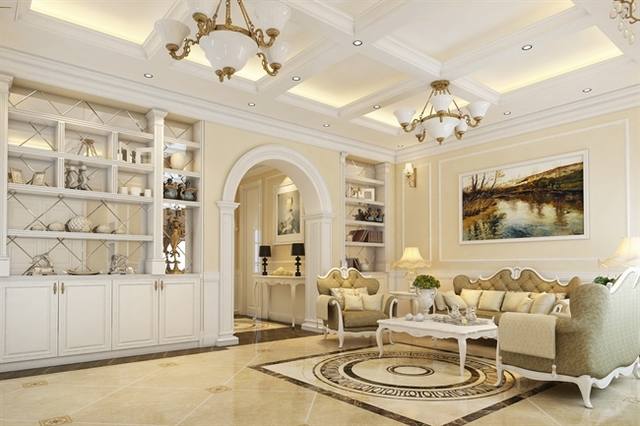
Luxurious Classical Design Style
1. Symmetry and Balance
Classic interior design fundamentally emphasizes symmetry. These designs draw inspiration from Roman and Greek architecture, which are characterized by carefully arranged and balanced compositions. Today, any classical interior design focuses primarily on arrangement and spatial symmetry to achieve an authentic classical aesthetic.
Symmetrical arrangements can be created by dividing a space down the center, with each half mirroring the other. However, furnishings need not be identical; they can reflect opposing walls through coordinated tones and color palettes.
Classical design places great importance on achieving perfect symmetry. Every detail matters in classical design. From the placement of artwork to the selection of lighting fixtures, this style demands meticulous attention to detail.
2. Color:
Classical interior design typically focuses on a color palette inspired by nature, such as grays, warm yellows, or other naturally occurring tones. However, cream and white are the two most frequently used colors in classical style. White serves as an element that makes gilded architectural details appear even more prominent and luminous. Additionally, muted tones such as wood brown are commonly found in classical interior design schemes.
In traditional classical style design, the emphasis is not on modernity; therefore, every element must be carefully selected to create perfect harmony with traditional colors. Color should not serve as the focal point of a traditional space; rather, it should function as a backdrop and create an overall sense of warmth throughout the room.
The Classic Reinterpreted Style allows for the introduction of contemporary colors. This approach permits you to incorporate modern furnishings into your interior design. You may select several vibrant colors for your decorative accessories.
In traditional style, dark wood tones are always the preferred choice: examples include oak and mahogany. It would be difficult to achieve a sense of depth if these were replaced with bamboo or lighter wood. However, to successfully achieve classical style, it is not necessary to cover everything entirely in wood—a single small detail, such as wooden ceiling beams or stair railings, is sufficient to create a warm, inviting atmosphere in your home.
Use the most neutral colors (beige, brown, dark brown) as your primary palette, particularly when combined with warm browns, sky blue, red, and green tones. Keep your color scheme cohesive and harmonious; if you desire a brighter, more contemporary feel, maintain consistency within your chosen tones.
3. Focal Points
The focal point serves as the primary gathering point of a room. Classical design typically features prominent focal points. These focal points can be functional elements within the space, such as a grand fireplace, an impressive dining table positioned in the center of the room, an elegant winding staircase, or a large framed artwork. Once the focal point is established, all other furnishings function as decorative elements to enhance the prominence of this primary design feature.
4. Decorative Details
A hallmark of classical interior design is the use of intricate and highly artistic decorative details. The combination of soft, flowing lines and graceful curves creates an interior design that is luxurious, refined, and elegant.
Traditional style avoids sharp angles and strong linear elements, instead favoring soft, genteel curves and classical edges.
In this style, essential details include decorative moldings and trim that extend from the floor to the ceiling and encircle each architectural element. Examples include crown molding, baseboards, and cornices that run along walls, as well as the angles where walls meet ceilings and where walls meet floors. These elements are the key to classical style—regardless of whether your furnishings are somewhat eclectic, the addition of these architectural details will establish a classical aesthetic in your home.
Classical style emphasizes comfort and functionality. From architecture to furnishings, you should use your senses to arrange this space thoughtfully. Windows are a visual anchor in arranging furnishings within classical style.
5. Furniture – Materials Used
Furniture and materials in this style reflect the characteristics and aesthetics of past decades and centuries. To complement the refined and sophisticated silhouettes, classical furniture is typically crafted from premium materials such as wood, granite, leather, and felt. These pieces are meticulously crafted to impart a lustrous and luxurious appearance to the space. Sofas and chairs often feature generous proportions with polished leather and gracefully curved armrests.
A defining characteristic of this style is plush upholstered sofas with intricately carved trim details, featuring virtually no sharp angles throughout the design. Classical patterns are commonly used, incorporating flowing, soft, and graceful curves. Chairs are typically upholstered and elegantly finished, allowing residents to immediately appreciate the careful craftsmanship and warmth of the design. Each piece of furniture and chair conveys a sense of comfort. These decorative details are largely handcrafted with exceptional precision and often draw inspiration from architectural elements and botanical motifs found in nature, reflecting high artistic value and stylistic coherence.
Classical spaces are typically adorned with woven fabrics—a key choice in traditional design—such as cotton and natural fiber textiles. Draperies in rich colors from fabrics like damask and velvet add an air of elegance. Common woven fabric patterns in traditional style include florals, stripes, and even toile designs. Some designs incorporate other fabric varieties such as silk to elevate the classical aesthetic. However, it is important to note that woven fabrics should not serve as the primary decorative element in the room.
Of course, you can freely combine different furniture pieces to refresh a room, but you must carefully control their colors. Incorporate crystal elements in lighting fixtures, brass metals, and gilt frames for wall art.
6. Light:
Classical style is quite refined and sophisticated. To maintain this elegance, select lighting fixtures that establish the right mood and atmosphere. These need not be modern lighting devices; you can find several exquisite chandelier designs.
They provide both a warm ambiance with soft golden light while serving as an artistic focal point for the space. Lighting can transform everything in a room—not merely its physical appearance. It functions as both a decorative feature and can influence the overall environment of the space. For this reason, be thoughtful in your selection of lighting fixtures.
Semi-classical design style
Many people mistakenly believe that semi-classical (or neoclassical) interior design style originates from the West, but this is not necessarily the case. Neoclassical style is a design approach that incorporates modern elements and creates a harmonious blend suitable for various spatial applications. The beauty of the semi-classical home lies in this perfect proportion of blending, evoking both inspiration and refined luxury for the space while maintaining the comfort of modern amenities.
Semi-classical style – the harmonious intersection of classical and contemporary design
Due to this fundamental difference, semi-classical style is one of the most sought-after design approaches worldwide, ranking second only to contemporary style. Furthermore, the decorative motifs of semi-classical style are less abundant and lack the density of traditional classical ornamentation, instead featuring a subtle integration with numerous modern elements.
Modern design style
Among the many interior design styles available, modern design has become increasingly popular due to the positive qualities it brings to living spaces. Its fresh and open approach has inspired many homeowners to choose this style when building their homes.
Modern design represents a powerful departure from classical architecture, reflecting a new way of thinking that emerged from the explosive development of European societies in the late 19th and early 20th centuries.
Various modern projects share common characteristics: simplicity in volumetric composition, spatial organization, flexible floor plans, and facades. This style eliminates the decorative elements typical of classical design while embracing contemporary materials such as glass, steel, aluminum, concrete, and brick.
Characteristics of modern style in interior design
Modern interior design is an optimal choice for smaller spaces, as it creates the impression of a larger room than its actual dimensions and maximizes available space. Minimal structure, bold geometric forms, neutral colors accented with one deeper tone, polished furnishings, and asymmetrical balance are the defining characteristics of modern interior design.
Modern interior design style
The advantages of modern design lie in its comfort, harmonious spatial flow, elegance, and refined simplicity—avoiding excessive ornamentation or heavy geometric styling.
Colors in modern style
In modern design, colors are used in a neutral palette, with white typically serving as the dominant base color. Accent colors are then strategically applied to select wall areas to create focal points. However, this does not mean being rigid with color choices. Rather, it simply involves carefully pairing neutral tones with bold colors to create a striking impression.
There are numerous ways to select and combine colors to achieve remarkable effects. Regardless of which color scheme you choose, it is essential to maintain unity and harmony while considering the overall feel and selecting colors appropriate for each space.
Materials used
Modern interior design primarily utilizes industrial materials such as glass, concrete, chrome, and products created through contemporary technology.
Space division
In modern interior design, open spaces intentionally flow into one another. For example, living areas and kitchens can seamlessly connect in a single open space, particularly in homes with limited square footage.
This characteristic differs significantly from classical style, where homes designed in the classical tradition tend to emphasize formal separation, making it challenging to combine different spaces. In contrast, modern design allows this integration with ease, as all design elements maintain visual continuity.
Light
Natural light is important in any interior design style, but it is particularly essential in modern design. Architects typically maximize window design and strategically position window treatments to allow natural light to flood the space.
Interior arrangement
For modern homes, furnishing choices should prioritize functional design with clean lines and refined aesthetics. Interior details should be arranged thoughtfully, with simplicity and orderliness as guiding principles.
Each furnishing element should function as a work of art, commanding its own space while remaining both striking and harmonious with the overall design. Avoid overcrowding, which creates a sense of visual clutter and discomfort. Consider bold presentation strategies by confidently employing geometric forms, expansive surfaces, and distinct color palettes to achieve optimal visual impact for your home.
THE SAIGON LUXURY JOURNAL
October 13, 2019
ANOTHER VIEW OF SAIGON
Stories for people who appreciate living space.
Selected by the Saigon Luxury editorial team — where real estate meets architecture, culture and contemporary lifestyle.
Investment Analysis, Luxury Trend, Market Analysis, Project Information
# Explaining Why Vinhomes Green Paradise Twin Villas Appeal to the Refined Taste of the Affluent Class
Or alternatively:
**The Reasons Vinhomes Green Paradise Twin Villas Satisfy the Investment Preferences of the Elite Segment**



 Symmetrical arrangements can be created by dividing a space down the center, with each half mirroring the other. However, furnishings need not be identical; they can reflect opposing walls through coordinated tones and color palettes.
Classical design places great importance on achieving perfect symmetry. Every detail matters in classical design. From the placement of artwork to the selection of lighting fixtures, this style demands meticulous attention to detail.
Symmetrical arrangements can be created by dividing a space down the center, with each half mirroring the other. However, furnishings need not be identical; they can reflect opposing walls through coordinated tones and color palettes.
Classical design places great importance on achieving perfect symmetry. Every detail matters in classical design. From the placement of artwork to the selection of lighting fixtures, this style demands meticulous attention to detail.
 The Classic Reinterpreted Style allows for the introduction of contemporary colors. This approach permits you to incorporate modern furnishings into your interior design. You may select several vibrant colors for your decorative accessories.
In traditional style, dark wood tones are always the preferred choice: examples include oak and mahogany. It would be difficult to achieve a sense of depth if these were replaced with bamboo or lighter wood. However, to successfully achieve classical style, it is not necessary to cover everything entirely in wood—a single small detail, such as wooden ceiling beams or stair railings, is sufficient to create a warm, inviting atmosphere in your home.
Use the most neutral colors (beige, brown, dark brown) as your primary palette, particularly when combined with warm browns, sky blue, red, and green tones. Keep your color scheme cohesive and harmonious; if you desire a brighter, more contemporary feel, maintain consistency within your chosen tones.
The Classic Reinterpreted Style allows for the introduction of contemporary colors. This approach permits you to incorporate modern furnishings into your interior design. You may select several vibrant colors for your decorative accessories.
In traditional style, dark wood tones are always the preferred choice: examples include oak and mahogany. It would be difficult to achieve a sense of depth if these were replaced with bamboo or lighter wood. However, to successfully achieve classical style, it is not necessary to cover everything entirely in wood—a single small detail, such as wooden ceiling beams or stair railings, is sufficient to create a warm, inviting atmosphere in your home.
Use the most neutral colors (beige, brown, dark brown) as your primary palette, particularly when combined with warm browns, sky blue, red, and green tones. Keep your color scheme cohesive and harmonious; if you desire a brighter, more contemporary feel, maintain consistency within your chosen tones.


 Each furnishing element should function as a work of art, commanding its own space while remaining both striking and harmonious with the overall design. Avoid overcrowding, which creates a sense of visual clutter and discomfort. Consider bold presentation strategies by confidently employing geometric forms, expansive surfaces, and distinct color palettes to achieve optimal visual impact for your home.